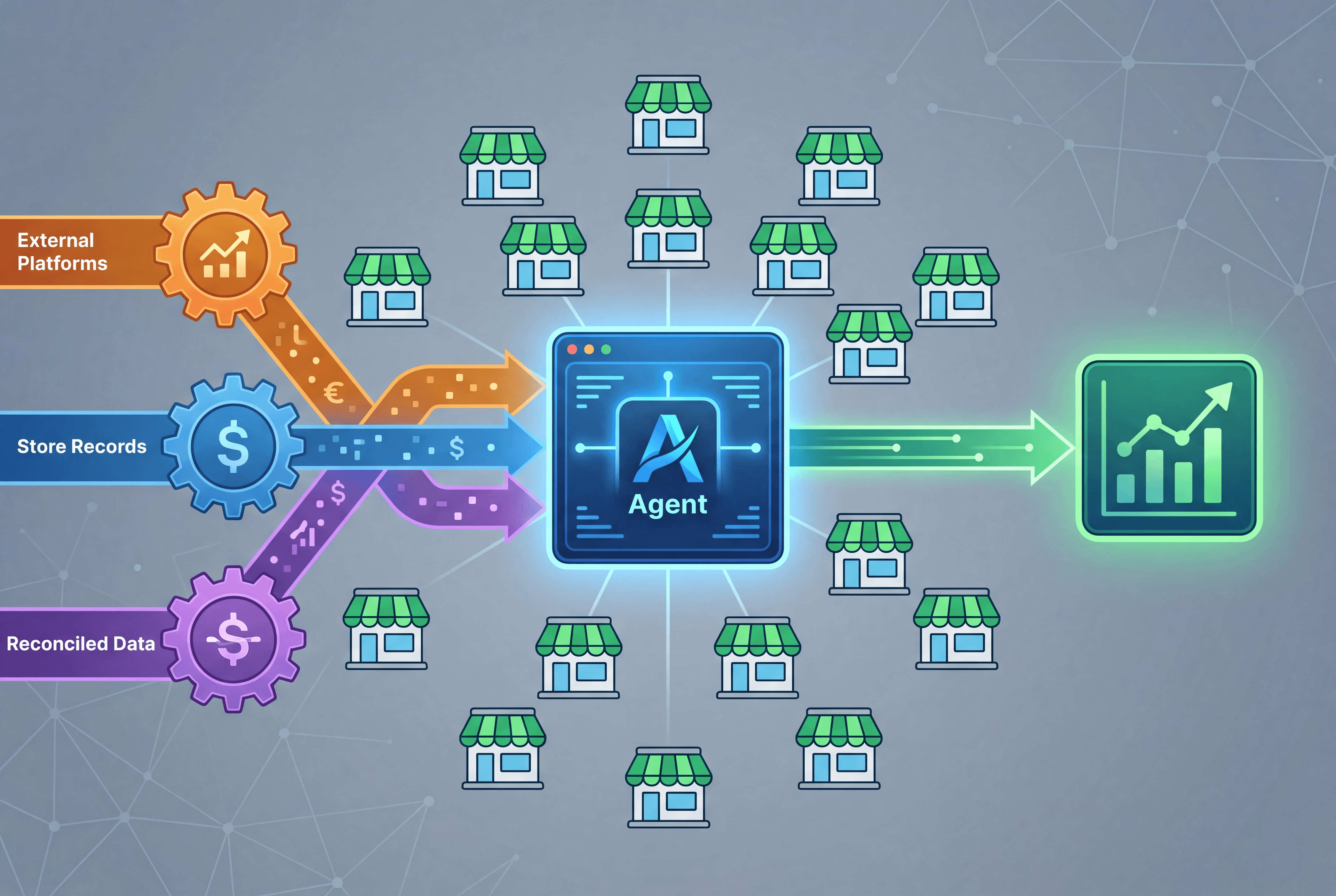
The restaurant industry occupies a unique space in the consumer goods sector — high daily turnover, long operational chains, and multiple revenue channels. A casual Chinese restaurant chain is a textbook example. Starting from a single street-side shop five years ago, it has grown to 12 company-owned stores concentrated in the business districts of a rapidly growing Chinese city. Each store generates between 6,000 and 15,000 RMB in daily revenue, split across three distinct streams: dine-in, food delivery platforms, and corporate catering. Store teams consist of a store manager plus kitchen and front-of-house staff. Headquarters, located on the other side of the city, has two finance staff, three operations staff, and one procurement manager. The founder worked his way up from being a chef — strict about food quality, but when it comes to financial and operational data, he admits, "I can never figure out where the profit goes." Among restaurant owners, this is a nearly universal sentiment. Revenue reconciliation in a restaurant is far more complicated than outsiders realize. For delivery alone, every store is listed on two platforms simultaneously — Meituan and Ele.me — each with its own billing cycle, commission structure, subsidy allocation, and refund policy. Every month, the head office finance team must download settlement statements from both platforms for all 12 stores and reconcile them line by line against the stores' POS data. A single platform statement contains anywhere from dozens to hundreds of transactions; just verifying the delivery revenue takes two full days per finance staff member. Corporate catering adds another layer of complexity — corporate clients are billed monthly, but orders change mid-month, cancellations happen, and invoices are issued before payment arrives. Finance needs to manually track the status of every accounts receivable entry. On one occasion, a long-term corporate client's actual headcount came in 20 meals short of their reservation. The store failed to confirm the discrepancy in time, and by month-end the client had overpaid. It took over a month of back-and-forth to recover the money. The owner calculated that the monthly labor cost of reconciling platform statements and tracking receivables exceeded 10,000 RMB — and that was just the visible cost. The actual losses from missed reconciliation errors were impossible to quantify. Why Traditional Solutions Failed The team had tried mainstream restaurant management systems, but these tools are essentially built around ordering, kitchen printing, and inventory management — they offer almost nothing for multi-platform reconciliation. Some restaurant SaaS products include financial reporting modules, but these only aggregate POS-side data; delivery platform statements still have to be exported and reconciled manually. They also tried Excel templates, with separate sheets for dine-in revenue, delivery revenue, and corporate catering revenue, plus a pivot table for aggregation. But every time a platform changed its commission structure, the formulas broke — producing negative figures or double counts. The team even considered hiring a dedicated accounts receivable clerk. However, margins in the restaurant business are razor-thin — covering one extra salary requires selling hundreds of extra meals each month. After weighing the costs, the owner decided against it. The hard truth is that restaurant management systems solved the "order-to-kitchen" workflow, but the "payment-to-ledger" side remained stubbornly manual. Vendor Selection & Customer Concerns The operations manager first heard about Docify in an industry WeChat group. Her immediate reaction was "another AI gimmick." But someone in the group posted a comparison chart — the time difference between manual reconciliation and AI-powered reconciliation was so dramatic that it caught her attention. She scheduled a demo. The presenter didn't talk up AI concepts; instead, they asked for three real platform settlement statements and three store POS reports to run a live test. The result was unexpected. Docify ingested all six documents in under ten minutes, completed line-by-line matching, and flagged seven amount discrepancies and two suspected duplicate settlements. The operations manager was skeptical. She manually verified every line against the original documents and found that eight of the nine flagged items were genuine issues — only one was a false positive caused by differing commission calculation methods. That accuracy rate convinced her. But the owner had another concern: most store managers had risen from the kitchen and weren't comfortable with computers. Would the system add to their workload? The Docify team proposed a simple solution — the stores only needed to do one thing: upload their daily POS reports and delivery platform screenshots when closing. Everything else would be handled automatically. Docify Implementation & Solution Implementation happened in two phases. Phase one: the head office entered all 12 stores' basic information, bank accounts, delivery platform store profiles, and commission structures into the system, building a simple reconciliation rule base. Phase two started with a pilot run at two stores and rolled out to all 12 after stability was confirmed. The daily workflow was stripped down to the minimum: each store uploads its daily POS report and delivery platform screenshots when closing. Docify's AI OCR automatically extracts all data fields, then completes three-way reconciliation — dine-in revenue, delivery platform settlements, and corporate catering receivables — matching every entry line by line. Any amount discrepancy, abnormal commission charge, or overdue corporate receivable is automatically flagged. Every morning, the finance team opens the system and reviews only the flagged exceptions instead of flipping through stacks of reports. A feature that surprised the owner was the operational knowledge base. The head office archived all 12 stores' standardized operating procedures, recipe SOPs, and food safety checklists into the knowledge base. New store managers no longer rely entirely on veteran employees for onboarding — they can search for standard answers themselves. All stores now follow unified ingredient inspection criteria and waste reporting procedures. When an operations audit finds an issue, store staff can look up the corresponding corrective action directly in the knowledge base. Measurable Results After four months of live operation, the numbers were clear. Three-way reconciliation time across all 12 stores dropped from 32 person-hours per month to under 4 person-hours — an efficiency improvement of nearly 87%. The detection rate for delivery platform settlement errors rose sharply. Over three months, the system flagged 47 platform settlement anomalies totaling more than 12,000 RMB, all of which were recovered. After the overdue receivable reminder feature was activated, the longest corporate catering collection cycle shortened from 75 days to 42 days. On the headcount front, the finance team was not expanded — the two existing staff members shifted from manual reconciliation to store-level gross margin analysis and ingredient waste tracking. For the first time, the owner received a report showing the true gross margin of each dish at each store. He remarked that after five years in the restaurant business, it was the first time he knew which dishes actually made money and which ones were just busywork making no profit. Customer Feedback At a management meeting, the owner put it bluntly: "I used to think reconciliation was just grunt work — something to endure. Now I realize that five years of 'enduring' cost me five years of profit." The operations manager offered a more practical take: "What I dreaded most was opening the delivery platform statement at month-end and finding a pile of discrepancies — then having to argue with platform reps one by one. Now the system surfaces them for me in advance. I just bring the evidence and negotiate." The finance lead's feedback was the shortest and most telling: "Before the system, none of us could leave before the 5th of the month. Now we wrap up reconciliation by the morning of the 1st and spend the afternoon on work that actually matters." Summary A common challenge for restaurant chains during rapid expansion is that more stores and more channels drive the complexity and error rate of financial control exponentially higher. Dine-in, delivery, and corporate catering operate as three independent revenue streams with no built-in cross-checking mechanism — everything is manually bridged, which is expensive, inefficient, and risky. Docify's approach is straightforward: it doesn't change the store's daily routine. It shifts reconciliation from "manual line-by-line comparison" to "AI-powered comparison, human exception review" — with an entry barrier as low as taking a photo and uploading it. For restaurant chains with 10 to 50 stores, the real value isn't just the time saved in the finance department; it's the previously invisible losses — platform underpayments, corporate catering bad debts, duplicate reimbursements — that the system catches one by one. In the consumer retail industry, competition has already moved from the dining room to the kitchen and from the menu to the ledger. The chains that manage their finances more granularly are the ones that survive in an industry where every margin point counts.
Customer CasesRetail, Consumer Goods & Entertainment
Three Revenue Channels, 12 Stores, One Reconciliation Nightmare: How a Chain Restaurant Brand Used Docify Agent to Stop Platform Bills and Store Ledgers from Clashing
Published on Jul 8, 2026Three Revenue Channels, 12 Stores, One Reconciliation Nightmare: How a Chain Restaurant Brand Used Docify Agent to Stop Platform Bills and Store Ledgers from Clashing
The restaurant industry occupies a unique space in the consumer goods sector — high daily turnover, long operational ...
After four months of live operation, the numbers were clear. Three-way reconciliation time across all 12 stores dropped from 32 person-hours per month to under 4 person-hours — an efficiency improvement of nearly 87%. The detection rate for delivery platform settlement errors rose sharply. Over three months, the system flagged 47 platform settlement anomalies totaling more than 12,000 RMB, all of which were recovered. After the overdue receivable reminder feature was activated, the longest corporate catering collection cycle shortened from 75 days to 42 days. On the headcount front, the finance team was not expanded — the two existing staff members shifted from manual reconciliation to store-level gross margin analysis and ingredient waste tracking. For the first time, the owner received a report showing the true gross margin of each dish at each store. He remarked that after five years in the restaurant business, it was the first time he knew which dishes actually made money and which ones were just busywork making no profit.
Core Outcome
· All product performance, effects and case data contained herein are for reference only and shall not constitute a basis for performance of contract. Actual results shall be subject to your company's on-site testing.
Related Articles
Customer CasesRetail, Consumer Goods & Entertainment
Retail Chain Trapped in System Silos? Docify Bridges Three Data Sources, Triples Reconciliation Efficiency
In 2026, a regional retail chain operating 22 convenience stores and 3 fresh-food mini-supermarkets is facing a disti...
Jul 8, 2026

Customer CasesTechnology, Internet & Telecom
A SaaS Company Was Drowning in Hiring. Three AI Tools Cut Their Screening Time by 3x.
A fast-growing AI SaaS company headquartered in Austin, with about 120 employees—over 65% of them in R&D. The company...
Jul 8, 2026

Customer CasesEducation, Government & Nonprofits
Escape the Maze of Paperwork: How Docify Empowers Government and Educational Institutions with Digital Archive Management
In educational institutions, government departments, and non-profit organizations (NPOs), documentation is the corner...
Jul 8, 2026