A Portland-based specialty coffee chain, six years in business, 42 company-owned locations, and a head office with barely 30 people. Founder Megan Walsh built the brand on product quality — single-origin sourcing, house-made syrups, precision brewing. But when it came to store operations, she'd admit the last six years had been a constant game of catch-up. The 42 stores were spread across Portland, each generating daily revenue reports, supply receipts, expense tickets, and employee time sheets. When month-end hit, the accounting team of three might as well have set up camp in the office. What kept Megan up at night was monthly reconciliation. Forty-two stores, each doing anywhere from thirty to well over a hundred transactions a day. The POS system generated a basic ledger, but the store managers' expense reports, supply invoices, and miscellaneous receipts were all physical paper. At the end of each month, managers would snap photos of their receipts and post them in a group chat, or drop off a manila envelope at the head office. The accounting team had to check every single one: does this receipt amount match? Is this expense within budget? Does this store's daily revenue align with what was actually deposited? Last month, a downtown location submitted a $530 supply receipt. It took the accountants three days to figure out it was fake — the store manager had gotten a handwritten receipt from a corner hardware store. The company ate the loss. Another store's revenue had been off for two consecutive months. It turned out an employee had been manipulating the discount system, pocketing the difference. By the time it was caught, the total hit was over three thousand dollars. Megan's reaction wasn't anger — it was fear. Forty-two stores, three accountants, hundreds of transactions every day. She had no idea how many more holes were out there. The other headache was operational consistency. The product team released new seasonal drinks every quarter with detailed SOPs — espresso extraction time, milk foam texture, syrup ratios, garnish standards — all written up and sent to every store. But when the ops team did store visits after each launch, eight out of ten shops were inconsistent. Some stores cut corners to speed up service. Others substituted cheaper ingredients on their own. Some managers never even read the full SOP. Megan had tried sending field supervisors on weekly store audits, but two supervisors couldn't cover 42 stores effectively. They'd visit, make mental notes, and the scores were always subjective. As for training materials, seasonal launch guides, and store display standards — everything lived in scattered WeChat groups and shared folders. Every time a store manager left, their knowledge left with them. Every new hire had to be taught from scratch. It wasn't that they hadn't tried software solutions. The stores used a third-party POS that could generate basic sales data but couldn't handle expense approval. Megan tried rolling out a standardized expense app across all stores, but the store managers found it too cumbersome — take a photo, fill in multiple fields, submit, wait for approval — the workflow was too heavy for busy baristas. Within a couple of months, everyone stopped using it. She looked into outsourcing month-end reconciliation to an accounting firm, but the outside team didn't understand the business. They had to call each store to verify every single receipt, which made the cycle even longer. As for operational standards — they'd printed paper SOP manuals, but managers were too busy to flip through them. They considered video training, but the production cost and update frequency were too high. One video was made, then the project stalled. Megan summed it up herself: it wasn't that people didn't want to be organized. It was that every step of every process required a human to watch, chase, and verify. The team's bandwidth simply couldn't scale with the store count. Megan heard about Docify from a fellow coffee chain owner in Seattle who had been using it for six months. Over dinner, the friend pulled out her phone and showed Megan the backend dashboard — all store revenue reconciliation, expense approvals, and receipt archiving running in one system. Megan was intrigued, but she didn't rush. She had her accounting lead pull three months' worth of the messiest receipts and expense data and ran a live test with the Docify team. Two things worried her most. First: could the OCR handle coffee shop receipts — thermal paper that had already faded, handwritten delivery notes from local suppliers with messy penmanship? Second: would 42 store managers actually use the system — if the process was too complicated, frontline staff would resist. Docify's team ran an OCR recognition test using real store receipts. The extraction accuracy for faded thermal receipts and handwritten notes passed the bar. Megan also had one store manager test the workflow — snap a photo, let the system auto-extract the amount, date, and category, and the manager just had to confirm. The store manager's feedback came back in one sentence: "Faster than filling out my Excel sheet." Once Docify went live, the accounting team felt the difference first. With Docify's retail OCR in place, store managers snapped photos of supply receipts, expense tickets, and miscellaneous invoices daily. The system automatically extracted the key fields — amount, date, vendor, category — and filed them under the correct store's ledger. Before, the three-person accounting team spent a full week at month-end reconciling 42 stores. Now, receipts were collected in real time and auto-classified. Month-end work dropped to two days of reviewing exceptions. The week that used to be the most brutal — late nights cross-referencing receipts, matching ledgers, calling store managers for verification — became a quick two-day cleanup. The second transformation came in expense compliance. Docify's AI financial audit module automatically validated every receipt against policy — was the amount within budget? Was the invoice authentic? Had it already been submitted for reimbursement? That fake $530 supply receipt from the downtown store? The system flagged it as an exception the moment it was uploaded. The store manager had to submit an explanation in the system before the expense could proceed through approval. Meanwhile, the AI automatically compared each store's daily POS revenue against actual bank deposits and pushed alerts for any discrepancies. In its first two months, the system intercepted four irregular expense claims and flagged two revenue discrepancies — catching leaks that had previously been invisible. On the operational standards front, Megan had the team upload all SOPs, training materials, seasonal launch guides, and store display standards into Docify's enterprise knowledge base. Before each new seasonal launch, the head office published the SOP and training materials in the knowledge base, and the system automatically pushed notifications to every store manager's account. Managers no longer had to hunt through group chats or shared folders — they opened the knowledge base and saw the latest version. When the field supervisors conducted post-launch store audits, they pulled the standard from the knowledge base on their phones, checked each item, and the scores were automatically aggregated in the backend. Before Docify, it took three to four weeks to get reasonable consistency after a seasonal launch. By the second week after launch, store audit pass rates had climbed from under 40% to over 80%. The numbers told the real story. On the accounting side: receipt processing efficiency improved by 85%. Month-end reconciliation dropped from 7 days to 2 days. Average monthly receipt processing time per store went from 3 hours to 20 minutes. On compliance: AI financial audit intercepted 4 irregular claims and flagged 2 revenue discrepancies in its first two months, preventing approximately $4,500 in potential losses. On operational standards: SOP rollout time after seasonal launches shortened from 4 weeks to 2 weeks. Store audit pass rates improved from under 40% to 85%. New manager onboarding time went from two weeks to three days. On cost: the accounting team went from 3 people to 1.5 (with one person reassigned to an operations support role). Per-store back-office management costs dropped roughly 35%. Megan ran the numbers herself: the combined value delivered by the system over six months was more than eight times the implementation cost. Megan later shared this at a franchisee networking event. She kept it real: "Anyone in the chain business knows the same truth — the more stores you open, the less visibility you have. When I had four stores, I could personally verify every location's books and check every drink. At 42 stores, I don't even know half my store managers' names. Accounting reconciliation was three people running on pure adrenaline. Operational standards relied on two field supervisors covering 42 stores on foot. Training materials lived in group chat threads. We were building a firewall out of human effort. But a human-built firewall has gaps. Docify didn't replace anyone's job. It let us finally replace that leaky human firewall with a system — receipts come in automatically, exceptions trigger alerts automatically, standards get pushed to every store automatically. It's not a tool upgrade. It's a management upgrade — from 'people watching people' to 'the system running the business.'" The retail, consumer goods, and food & beverage industry runs on a simple logic — open more stores, scale faster. But most brands find that when they go from a handful of locations to several dozen, their management capacity can't keep up with store growth. The core contradiction is this: more stores mean exponentially more data, but human data processing has a hard ceiling. Docify's approach doesn't solve one or two isolated efficiency problems. It addresses the three critical pillars of chain operations — store revenue data aggregation, financial compliance verification, and operational standard institutionalization — and shifts them from a "people-watching-people" model to a "system-as-safety-net" model. For growing chains in their expansion phase, this isn't a nice-to-have digital upgrade. It's the infrastructure that lets management capacity keep pace with store growth — without blindly adding headcount, so that 42 stores can be managed with the same clarity as four.
Customer CasesRetail, Consumer Goods & Entertainment
40 Stores, One Accountant, Spreadsheets Everywhere — How a Portland Coffee Chain Broke Free from Chaotic Retail Management
Published on Jul 8, 202640 Stores, One Accountant, Spreadsheets Everywhere — How a Portland Coffee Chain Broke Free from Chaotic Retail Management
A Portland-based specialty coffee chain, six years in business, 42 company-owned locations, and a head office with ba...
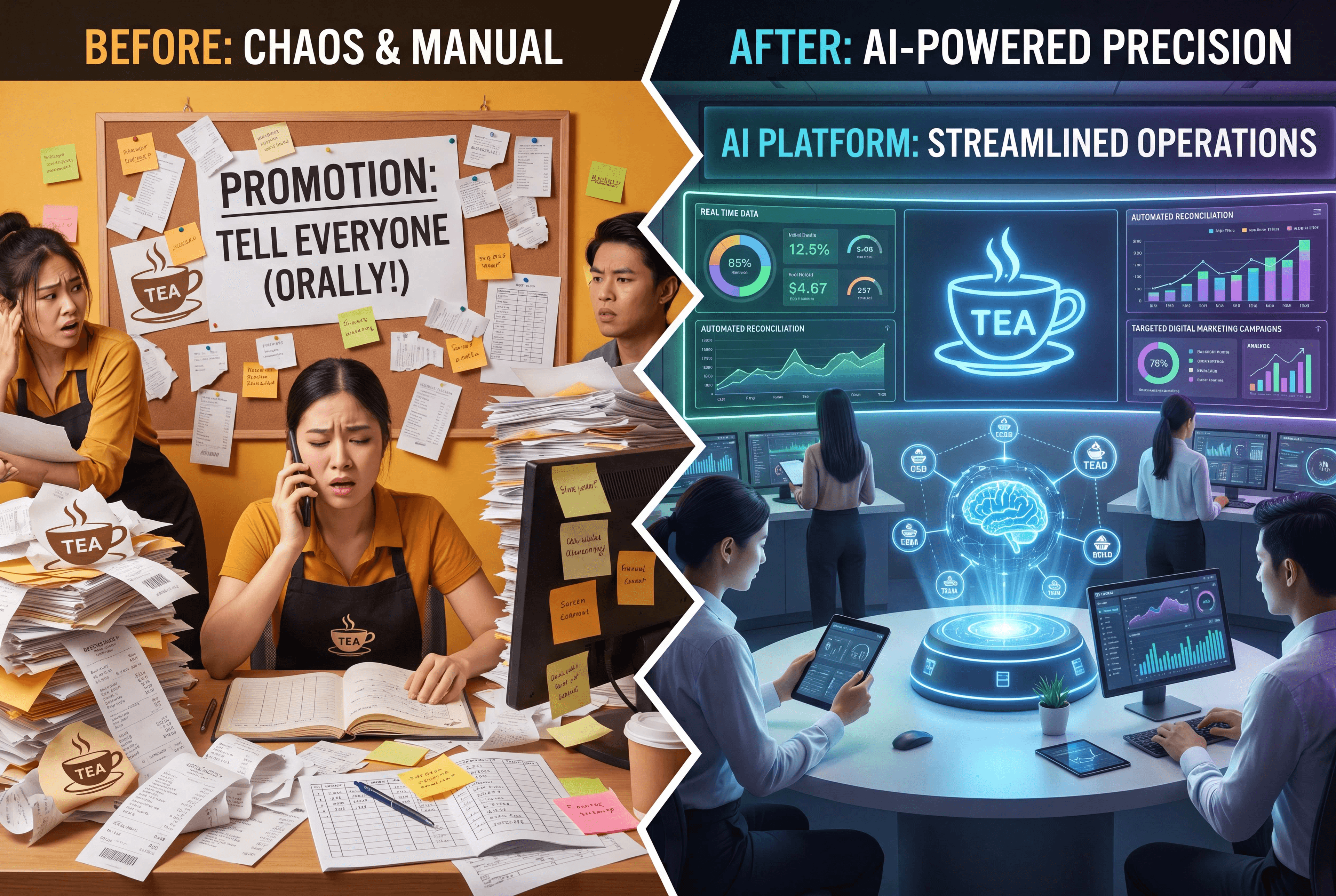
Once Docify went live, the accounting team felt the difference first. With Docify's retail OCR in place, store managers snapped photos of supply receipts, expense tickets, and miscellaneous invoices daily. The system automatically extracted the key fields — amount, date, vendor, category — and filed them under the correct store's ledger. Before, the three-person accounting team spent a full week at month-end reconciling 42 stores. Now, receipts were collected in real time and auto-classified. Month-end work dropped to two days of reviewing exceptions. The week that used to be the most brutal — late nights cross-referencing receipts, matching ledgers, calling store managers for verification — became a quick two-day cleanup. The second transformation came in expense compliance. Docify's AI financial audit module automatically validated every receipt against policy — was the amount within budget? Was the invoice authentic? Had it already been submitted for reimbursement? That fake $530 supply receipt from the downtown store? The system flagged it as an exception the moment it was uploaded. The store manager had to submit an explanation in the system before the expense could proceed through approval. Meanwhile, the AI automatically compared each store's daily POS revenue against actual bank deposits and pushed alerts for any discrepancies. In its first two months, the system intercepted four irregular expense claims and flagged two revenue discrepancies — catching leaks that had previously been invisible. On the operational standards front, Megan had the team upload all SOPs, training materials, seasonal launch guides, and store display standards into Docify's enterprise knowledge base. Before each new seasonal launch, the head office published the SOP and training materials in the knowledge base, and the system automatically pushed notifications to every store manager's account. Managers no longer had to hunt through group chats or shared folders — they opened the knowledge base and saw the latest version. When the field supervisors conducted post-launch store audits, they pulled the standard from the knowledge base on their phones, checked each item, and the scores were automatically aggregated in the backend. Before Docify, it took three to four weeks to get reasonable consistency after a seasonal launch. By the second week after launch, store audit pass rates had climbed from under 40% to over 80%.
Core Outcome
The numbers told the real story. On the accounting side: receipt processing efficiency improved by 85%. Month-end reconciliation dropped from 7 days to 2 days. Average monthly receipt processing time per store went from 3 hours to 20 minutes. On compliance: AI financial audit intercepted 4 irregular claims and flagged 2 revenue discrepancies in its first two months, preventing approximately $4,500 in potential losses. On operational standards: SOP rollout time after seasonal launches shortened from 4 weeks to 2 weeks. Store audit pass rates improved from under 40% to 85%. New manager onboarding time went from two weeks to three days. On cost: the accounting team went from 3 people to 1.5 (with one person reassigned to an operations support role). Per-store back-office management costs dropped roughly 35%. Megan ran the numbers herself: the combined value delivered by the system over six months was more than eight times the implementation cost.
Core Outcome
· All product performance, effects and case data contained herein are for reference only and shall not constitute a basis for performance of contract. Actual results shall be subject to your company's on-site testing.
Related Articles

Customer CasesRetail, Consumer Goods & Entertainment
Retail Chain Trapped in System Silos? Docify Bridges Three Data Sources, Triples Reconciliation Efficiency
In 2026, a regional retail chain operating 22 convenience stores and 3 fresh-food mini-supermarkets is facing a disti...
Jul 8, 2026

Customer CasesTechnology, Internet & Telecom
A SaaS Company Was Drowning in Hiring. Three AI Tools Cut Their Screening Time by 3x.
A fast-growing AI SaaS company headquartered in Austin, with about 120 employees—over 65% of them in R&D. The company...
Jul 8, 2026

Customer CasesEducation, Government & Nonprofits
Escape the Maze of Paperwork: How Docify Empowers Government and Educational Institutions with Digital Archive Management
In educational institutions, government departments, and non-profit organizations (NPOs), documentation is the corner...
Jul 8, 2026