A Chicago-based trucking company, ten years in business, 120-plus company-owned trucks, running over sixty routes daily across the Midwest and Eastern Seaboard. Founder Tom Walker started as a driver himself — took the fleet from two trucks to over a hundred in a decade, with revenue growing more than tenfold. But he'd be the first to admit that management capacity never kept pace with business growth. Six people in dispatch, four in accounting — and every day they faced mountains of paper waybills, shipping orders, and driver expense receipts. These documents were the company's lifeblood, but the way they were processed hadn't changed in ten years. What kept Tom up at night was waybill processing and freight reconciliation. The company ran over sixty routes daily. Each trip generated at least three to five waybills — a pickup bill, a transfer bill, a delivery receipt — plus split bills for LTL consolidation. On a slow day, that was three to four hundred documents. During peak season, it could hit a thousand. Every single one was a physical paper document. When a driver completed a run and returned to the yard, dispatch had to check each one, enter the data manually, and accounting had to match the waybills against client invoices and calculate driver settlements. Last month, a dispatcher who had been with the company for five years told Tom he wanted to quit. His reason: "My head spins every day staring at those papers. I'm terrified of making a mistake. The pressure is too much." Tom convinced him to stay, but he knew the real problem ran deeper than one person. The other major headache was driver expense reimbursement and reconciliation. With 120-plus trucks, each running multiple trips, every vehicle generated toll receipts, fuel receipts, parking tickets, and maintenance invoices. At month-end, drivers would hand over stacks of paper, and accounting had to verify every single one — does this toll receipt match the route? Is this fuel expense within normal range? Is this truck's maintenance frequency abnormal? Last year, one truck showed abnormally high fuel consumption for three consecutive months. The accounting team never caught it. It turned out the driver had been secretly reselling fuel cards. By the time it was discovered, the company had lost over nine thousand dollars. Tom later said the nine thousand wasn't the worst part. The worst part was knowing there were probably more holes like it hidden in those stacks of paper he had no way to see. It wasn't that they hadn't tried going digital. The company had invested in a transportation management system two years earlier, but it only handled vehicle dispatch and GPS tracking — waybills still had to be entered manually. They tried having drivers upload receipts via a mobile app, but drivers had unreliable signal on the road, and the app was too complicated. After two months, nobody was using it anymore. As for reconciliation — they tested outsourcing freight settlement to a third-party firm, but the outside team didn't understand the company's route pricing and contract terms. They had to confirm every single invoice with the company, which made the process even slower. Tom summed it up in one sentence: "A logistics company never lacks data. What it lacks is a tool that can clean that data, align it, and make it run." Tom heard about Docify from a friend who ran a smaller freight company. The friend had been using it for six months and said the biggest change was "finally getting to sleep at month-end." Tom went to see it in person. When he got back, he had his accounting and dispatch teams pull three months' worth of waybills and expense data for a live test. Two things worried him most. First: could the OCR handle the wildly inconsistent document formats common in the logistics industry — full truckload bills, LTL split bills, delivery receipts — each with a different layout, some on three-part carbon copy paper with barely legible impressions? Second: could the reconciliation logic handle their complex pricing structure — different rates by route, by weight, by volume, by truck type, with different prices for different clients? Docify's team ran an OCR recognition test using the company's real waybills. The extraction accuracy for three-part carbon copy forms and faded delivery receipts passed the threshold. They spent three days together configuring the reconciliation rules, loading the company's core billing logic into the system. Tom saw the results and didn't hesitate. In the first month after Docify went live, the dispatch center felt the difference first. With Docify's logistics OCR in place, drivers handed over their waybills when they returned to the yard. Dispatch staff ran them through a document scanner or snapped a photo with a phone. The system automatically identified and extracted the key fields — origin, destination, cargo type, weight, volume, freight charges — wrote them directly into the system, and auto-filed them under the correct client and route ledger. Before, dispatch spent four to five hours every day manually entering waybill data. Now, everything was automated after the scan. Dispatch only needed to verify the extracted results and confirm with one click. Per-waybill processing time dropped from three to five minutes to under thirty seconds. The six-person dispatch team could wrap up by 5 PM — no more working until eight or nine at night. The second transformation came in financial reconciliation. With Docify's AI financial audit and auto-reconciliation Agent, the system automatically pulled waybill data every day, calculated expected receivables for each shipment based on the configured pricing rules, and ran automatic matches against client settlement statements. When amounts matched, they were auto-reconciled. When discrepancies appeared, the line items were flagged in red and pushed to the accounting team. Before, month-end meant the accounting team manually matching hundreds of waybills against client invoices, line by line. Now, over ninety percent of reconciliation was handled automatically. The finance team only needed to work through the exceptions highlighted in red. Driver expense reimbursement changed too: drivers snapped photos of toll receipts, fuel receipts, and maintenance invoices with their phones. The system auto-extracted amounts and categories, cross-referenced them against the route budget, and automatically flagged overspend items for dispatch review. In three months, the system intercepted twelve irregular expense claims — including the kind of fuel expense fraud that had previously been invisible. Before Docify, the accounting and dispatch teams had to work overtime for at least two weeks at month-end just to close the books. After Docify, the monthly reconciliation cycle dropped from fifteen days to three. Accuracy improved from under ninety percent manually to over ninety-nine percent. The numbers were clear. Waybill processing efficiency improved by over ninety percent. Daily waybill throughput went from three hundred-plus to over eight hundred — meaning the company could handle significantly more business without adding headcount. Freight reconciliation cycle dropped from fifteen days to three. Monthly reconciliation exceptions went from over a hundred down to single digits. Auto-reconciliation rate reached ninety-seven percent. On expense compliance: the system intercepted twelve irregular expense claims in three months, preventing approximately six thousand dollars in losses. Fuel consumption monitoring identified three trucks with fuel data that consistently deviated from route standards — investigations confirmed driver behavior and equipment issues in each case. After corrective action, average monthly fuel cost per truck dropped about eighteen percent. On headcount: dispatch went from six people to four (two were reassigned to customer service and route optimization). Accounting went from four to two. Tom ran his own numbers: the combined annual value — from waybill processing labor savings, reconciliation efficiency gains, fraud prevention, and fuel optimization — exceeded the implementation cost by more than twelve times. Tom later shared this at a logistics industry conference: "Anyone in trucking knows the truth — the trucks are out on the road, and the paperwork is piled on the desk. You can run the trucks as fast as you want, but if the paperwork doesn't keep up and the numbers don't add up, none of it matters. Our old approach was simple: add more people, add more overtime, add more desks. But human processing speed has a ceiling, and the more pressure you apply, the more mistakes you make. After Docify, dispatch doesn't have to sit there punching in waybill data all day. Accounting doesn't have to pull all-nighters at month-end matching invoices. Drivers don't have to wait months to get their expenses reimbursed. It's not that our people suddenly got more capable. It's that the work that didn't need to be done by people finally stopped being done by people. Let the AI handle the waybills. Let the system run the reconciliation. Let the alerts watch for exceptions. That's what a logistics company should look like." The logistics and transportation industry's core challenge has never been "do we have enough business." It's "can we handle the business we have, and can we settle it accurately once we do." In the traditional model, waybills are entered by hand, freight is reconciled by hand, expenses are checked by hand — every step depends on manual labor, and every step has a bottleneck and an error rate. Docify's value isn't about inventing breakthrough technology. It's about taking the dirty, repetitive work that every logistics company faces every day — digitizing paper waybills, automating freight reconciliation, intelligent expense checking — and having AI truly carry it, so the team's limited energy can shift from "data entry and number checking" to "route optimization and customer service." For any logistics company that lives and dies by paperwork, this isn't a nice-to-have digital add-on. It's the foundational upgrade that takes a company from human-powered to data-driven — no new hires, no extra overtime, just turning those mountains of paper into streams of data that run themselves.
Customer CasesTransportation, Logistics & Supply Chain
A Thousand Paper Waybills a Day, Reconciliation That Takes Weeks — How a Chicago Trucking Company Used AI to Cut Its Settlement Cycle from 15 Days to 3
Published on Jul 8, 2026A Thousand Paper Waybills a Day, Reconciliation That Takes Weeks — How a Chicago Trucking Company Used AI to Cut Its Settlement Cycle from 15 Days to 3
A Chicago-based trucking company, ten years in business, 120-plus company-owned trucks, running over sixty routes dai...
广州一家做了十年的干线物流公司,自有车辆一百二十多台,每天发车六十多个班次,覆盖珠三角到长三角的主要线路。老板老赵从司机做起,十年把车队从两台车干到上百台,业务量翻了十几倍,但他自己说,公司的管理能力从来没跟上过业务增长的速度。调度中心六个人,财务部四个人,每天面对的是堆积如山的纸质运单、托运单、司机报销单——这些单据就是公司运转的血脉,但处理它们的方式还停留在十年前。
Core Outcome
效果数据清清楚楚。运单处理效率提升90%以上,调度中心日均处理运单从三百多张增长到可承载八百张以上——意味着公司不用加人可以承接更大业务量。运费对账周期从十五天缩短到三天,每月对账差异项从一百多处降到个位数,自动勾对率达到百分之九十七。异常报销拦截方面,三个月内系统自动识别并拦截异常报销十二笔,涉及金额四万二千元,同时通过油耗比对发现三台车的燃油数据长期偏离路线标准,经查均为驾驶员操作或设备问题,及时整改后单车月均油费下降约百分之十八。人力释放上,调度中心从六人优化到四人(转岗两人做客户维护和线路优化),财务部从四人优化到两人。老赵自己算过:单是运单录入和对账环节释放的人力,加上异常报销拦截挽回的损失和油耗优化节省的成本,全年综合收益超过投入成本的十二倍。
Core Outcome
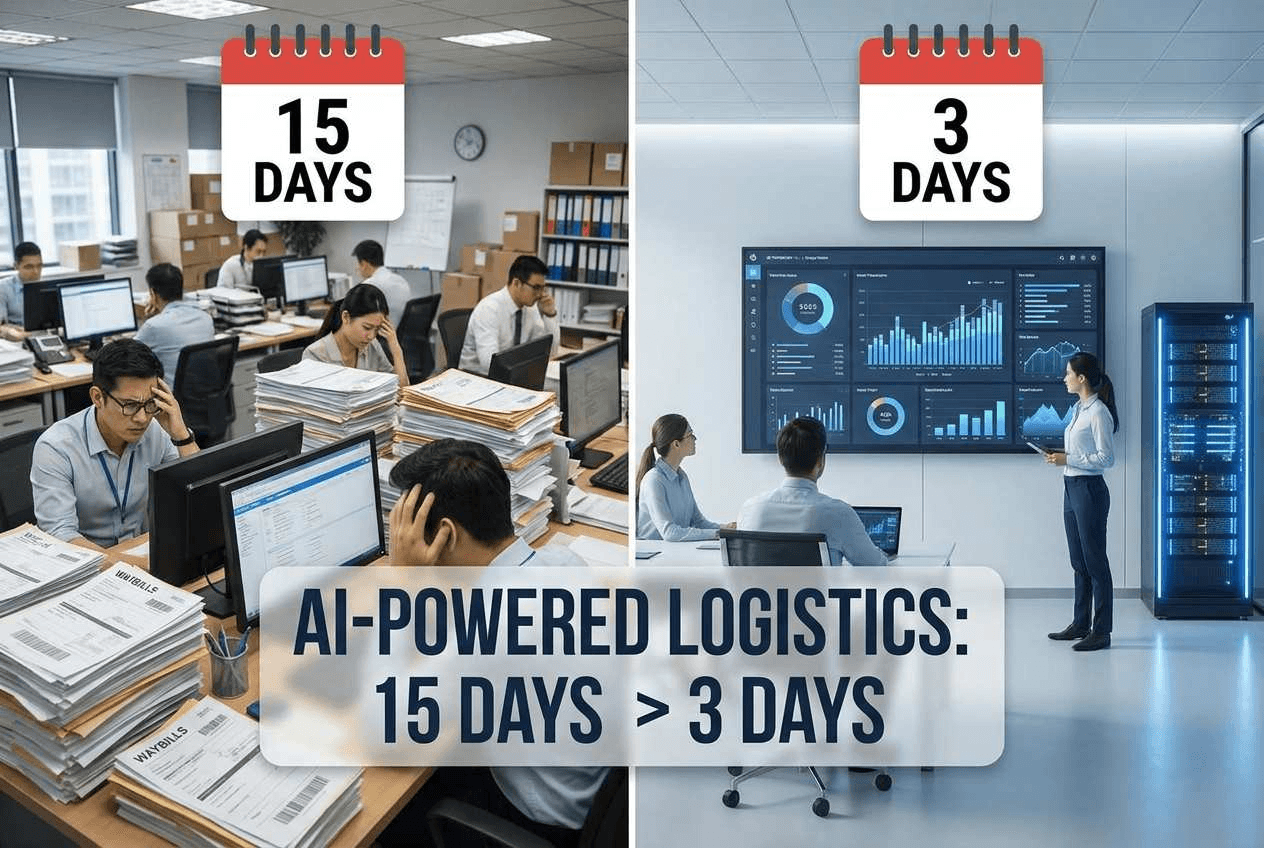
· All product performance, effects and case data contained herein are for reference only and shall not constitute a basis for performance of contract. Actual results shall be subject to your company's on-site testing.
Related Articles
Customer CasesRetail, Consumer Goods & Entertainment
Retail Chain Trapped in System Silos? Docify Bridges Three Data Sources, Triples Reconciliation Efficiency
In 2026, a regional retail chain operating 22 convenience stores and 3 fresh-food mini-supermarkets is facing a disti...
Jul 8, 2026

Customer CasesTechnology, Internet & Telecom
A SaaS Company Was Drowning in Hiring. Three AI Tools Cut Their Screening Time by 3x.
A fast-growing AI SaaS company headquartered in Austin, with about 120 employees—over 65% of them in R&D. The company...
Jul 8, 2026
Customer CasesEducation, Government & Nonprofits
Escape the Maze of Paperwork: How Docify Empowers Government and Educational Institutions with Digital Archive Management
In educational institutions, government departments, and non-profit organizations (NPOs), documentation is the corner...
Jul 8, 2026