Private healthcare providers in China face a silent but crushing burden: the management of paper medical records and clinical documents. A mid-sized hospital group operating three branches with nearly 500 beds spent the past three years drowning in medical records, test reports, admission forms, and nursing notes. Three departments—medical affairs, nursing, and medical records—were locked in a daily battle with paperwork. Nurses spent one to two hours after every shift manually transcribing nursing records. The medical records office manually filed over ten thousand discharge summaries each month. And every time the health authorities came for an inspection, the medical affairs team burned the midnight oil for a week straight just to pull the required documents. The breaking point came in the third quarter of last year. During an annual quality audit at one of the branches, three medical affairs staff worked five consecutive overtime days, pulling paper records from two storage rooms packed floor to ceiling. Even so, they missed two critical surgical records. The audit flagged the incomplete filing. That was the moment the vice president in charge of medical quality realized: relying on manual labor to manage documents was a ticking time bomb. The group had tried digital solutions before. Two years earlier, the IT department deployed an electronic medical record (EMR) system and a basic document management platform. But the reality on the ground was stubborn—the hospital still generated massive volumes of unstructured paper documents every day: referral records and test results from other hospitals, handwritten patient history forms, health check reports from third-party clinics, consultation requests circulating between departments. Every single piece of paper still had to be scanned, classified, and entered manually. The EMR system and the paper archive remained two separate worlds. The group also tried expanding the medical records team from six to ten people. Costs went up, but efficiency and accuracy barely budged. Veteran staff were burned out by repetitive data entry, while newcomers needed three months or more just to learn the classification and filing rules for dozens of different medical document types. Before committing to an AI solution, the management team had serious reservations. Medical data privacy was non-negotiable. Could OCR achieve over 99% accuracy on clinical terminology? Could the system tell the difference between "past medical history" and "history of present illness"—two sections that sound similar but are completely different in a medical record? Would the document classification logic align with the hospital's internal departmental structure, not just a generic folder tree? And after handing over the workload to AI, could the medical records and nursing staff actually use it day-to-day? The IT department benchmarked multiple AI document processing solutions. They chose Docify for three reasons: it supported on-premise deployment so data never left the hospital campus, fully meeting compliance requirements; in testing, Docify's general-purpose OCR delivered stable character recognition on printed medical records, lab reports, nursing notes, and other common clinical documents, and when paired with configurable classification rules it enabled automatic filing by department and year; and the product had a low learning curve—no dedicated AI operators needed on staff. The deployment centered on three areas. First, AI OCR for medical documents. The group started with the medical records office—every discharged patient's record was scanned and automatically recognized by Docify, which extracted structured fields and filed them under a three-level directory of department, year, and record number. Nursing followed next, routing daily nursing notes and shift handover logs through the same OCR pipeline, eliminating manual electronic transcription. Second, a compliance knowledge base. Medical affairs imported all quality management protocols, national clinical guidelines from the health commission, and hospital infection control standards into a searchable knowledge base. Clinical staff and nurses could retrieve relevant provisions through natural language queries instead of flipping through hundreds of pages of PDFs. Third, AI Agents. The group set up two key agents. The operations summary agent could be triggered by medical affairs staff whenever needed, pulling key operational data from each department and generating a briefing. The audit preparation agent worked with the compliance knowledge base—when preparing for an inspection, staff could ask the agent to walk through the inspection checklist, check filing status, and identify missing documents. This replaced what used to be days of manual searching, cross-referencing, and organizing. Three months after launch, the results were compelling. Monthly filing efficiency in the medical records office improved by 75%—the same workload that required ten people now needed six. Manual nursing documentation time dropped by roughly 80%, freeing nearly 1.5 hours per nurse per day for direct patient care. Medical affairs cut inspection preparation from five days to one. In the most recent district-level quality audit, the record completeness rate rose from 83% to 100%. Most importantly, the group achieved end-to-end traceability for paper medical documents for the first time—every record's location and status could be checked in real time in the system. The days of "searching the entire archive room and still not finding a record" were over. During an internal lessons-learned meeting, the head of medical affairs put it this way: "We always thought we were managing the documents. In reality, the documents were managing us. Whether it was an inspection or daily operations, the vast majority of our time went into searching, organizing, and cross-checking paperwork. The biggest change this system brought isn't just efficiency—it's that we can finally focus on things that actually affect patient care quality." The nursing director was even more direct: "A nurse's most valuable time belongs at the patient's bedside, not in front of a computer entering records. This system gave that time back." Looking back at this hospital group's journey, a common pattern across private healthcare in China comes into focus. Organizations spare no expense on hardware—medical equipment and information systems get upgraded year after year. But the "soft cost" of document chaos and procedural friction has been overlooked for far too long. Solving it doesn't require a technological revolution. A well-tailored combination of AI document processing, knowledge management, and workflow automation can free a hospital team of hundreds from low-value clerical work and redirect resources toward what actually matters: the quality of care. For any healthcare provider struggling with paper backlogs, compliance pressure, and excessive non-clinical workload on medical staff, this model offers a clear, repeatable path forward.
Customer CasesHealthcare & Life Sciences
Buried in Paper Records, Nurses Chained to Desks—How a Private Hospital Group Used AI to End Three Years of Document Chaos, Cutting Processing Time by 75%
Published on Jul 8, 2026Buried in Paper Records, Nurses Chained to Desks—How a Private Hospital Group Used AI to End Three Years of Document Chaos, Cutting Processing Time by 75%
Private healthcare providers in China face a silent but crushing burden: the management of paper medical records and ...
Before committing to an AI solution, the management team had serious reservations. Medical data privacy was non-negotiable. Could OCR achieve over 99% accuracy on clinical terminology? Could the system tell the difference between "past medical history" and "history of present illness"—two sections that sound similar but are completely different in a medical record? Would the document classification logic align with the hospital's internal departmental structure, not just a generic folder tree? And after handing over the workload to AI, could the medical records and nursing staff actually use it day-to-day? The IT department benchmarked multiple AI document processing solutions. They chose Docify for three reasons: it supported on-premise deployment so data never left the hospital campus, fully meeting compliance requirements; in testing, Docify's general-purpose OCR delivered stable character recognition on printed medical records, lab reports, nursing notes, and other common clinical documents, and when paired with configurable classification rules it enabled automatic filing by department and year; and the product had a low learning curve—no dedicated AI operators needed on staff.
Core Outcome
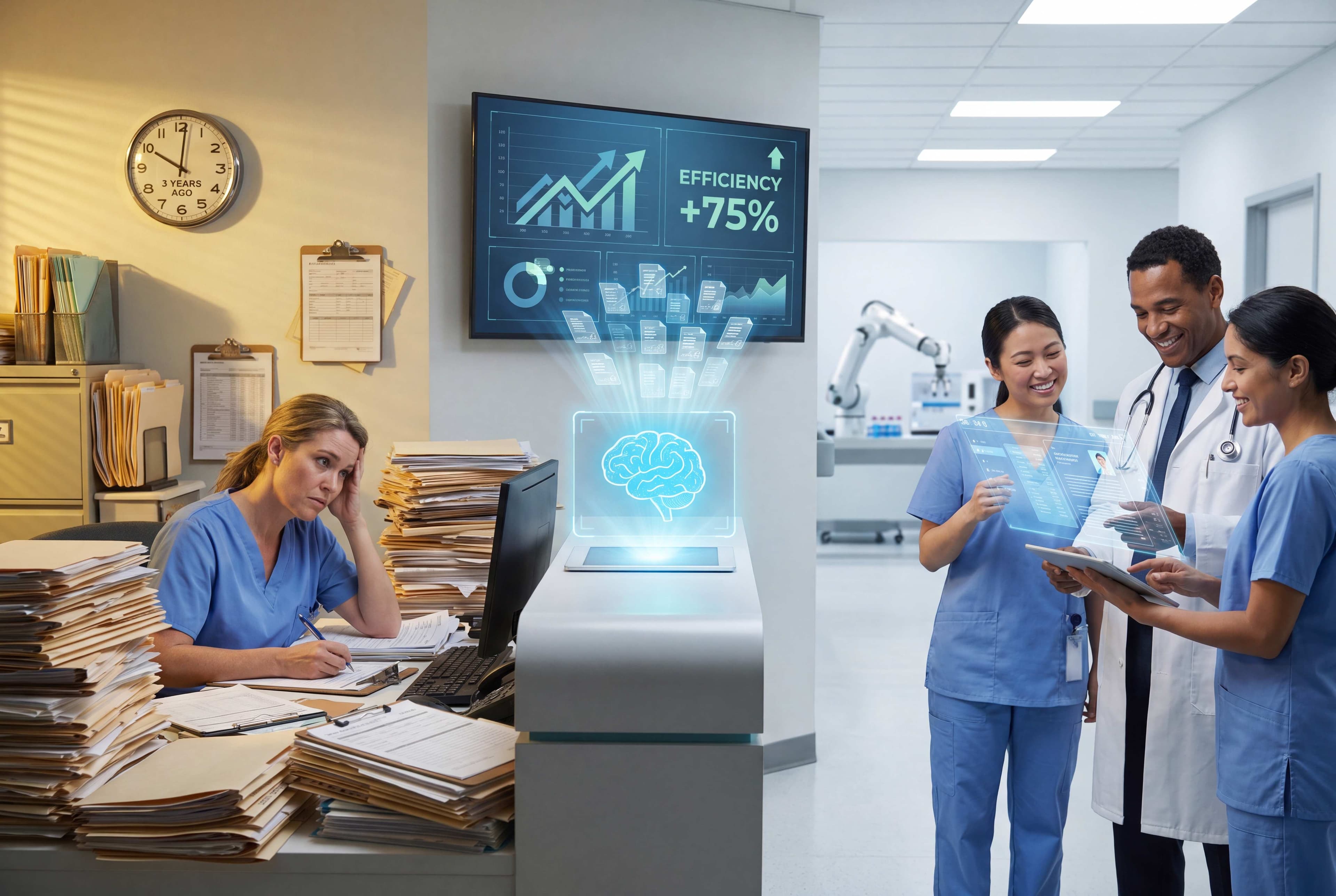
Three months after launch, the results were compelling. Monthly filing efficiency in the medical records office improved by 75%—the same workload that required ten people now needed six. Manual nursing documentation time dropped by roughly 80%, freeing nearly 1.5 hours per nurse per day for direct patient care. Medical affairs cut inspection preparation from five days to one. In the most recent district-level quality audit, the record completeness rate rose from 83% to 100%. Most importantly, the group achieved end-to-end traceability for paper medical documents for the first time—every record's location and status could be checked in real time in the system. The days of "searching the entire archive room and still not finding a record" were over.
Core Outcome
· All product performance, effects and case data contained herein are for reference only and shall not constitute a basis for performance of contract. Actual results shall be subject to your company's on-site testing.
Related Articles

Customer CasesRetail, Consumer Goods & Entertainment
Retail Chain Trapped in System Silos? Docify Bridges Three Data Sources, Triples Reconciliation Efficiency
In 2026, a regional retail chain operating 22 convenience stores and 3 fresh-food mini-supermarkets is facing a disti...
Jul 8, 2026

Customer CasesTechnology, Internet & Telecom
A SaaS Company Was Drowning in Hiring. Three AI Tools Cut Their Screening Time by 3x.
A fast-growing AI SaaS company headquartered in Austin, with about 120 employees—over 65% of them in R&D. The company...
Jul 8, 2026

Customer CasesEducation, Government & Nonprofits
Escape the Maze of Paperwork: How Docify Empowers Government and Educational Institutions with Digital Archive Management
In educational institutions, government departments, and non-profit organizations (NPOs), documentation is the corner...
Jul 8, 2026